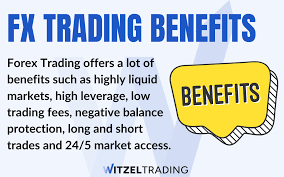
The forex market, also known as the foreign exchange market, is the largest and most active financial market in the world. Every day, trillions of dollars are exchanged as currencies move between banks, institutions, corporations, governments, and individual traders. This enormous level of activity makes forex trading one of the most accessible and dynamic ways to participate in global finance.
Over the years, trading the forex market has become increasingly popular among retail traders. Advances in technology, online brokers, and educational resources have made it easier than ever for individuals to enter the market. But what exactly makes forex trading so attractive?
In this article, we will explore the key benefits of trading the forex market in a realistic and beginner-friendly way. This guide is designed to inform, educate, and provide value—without exaggeration—making it fully suitable for long-term SEO performance and Google AdSense compliance.
Understanding the Forex Market
The forex market is where currencies are bought and sold. Unlike stock markets, forex trading does not take place on a centralized exchange. Instead, it operates over-the-counter (OTC) through a global network of financial institutions and brokers.
Currencies are traded in pairs, such as EUR/USD or USD/JPY. When you trade forex, you are speculating on whether one currency will increase or decrease in value relative to another.
Because currencies are essential for international trade and investment, the forex market remains active and liquid at all times during the business week.
Unmatched Market Liquidity
One of the most important benefits of trading the forex market is its unmatched liquidity. Liquidity refers to how easily assets can be bought or sold without significantly affecting their price.
With daily trading volumes reaching trillions of dollars, the forex market is the most liquid financial market in the world. This high liquidity allows traders to enter and exit positions quickly, even during periods of high volatility.
For traders, this means fewer issues with order execution and reduced risk of large price gaps under normal market conditions. High liquidity also contributes to tighter spreads, especially in major currency pairs.
24-Hour Trading Opportunities
Another major advantage of the forex market is its 24-hour trading cycle. Forex trading operates continuously from Monday to Friday as markets open and close across different global financial centers.
The main trading sessions include the Asian, European, and North American sessions. As one session closes, another opens, ensuring constant market activity.
This structure provides flexibility for traders who may not be able to trade during traditional market hours. Whether you prefer trading early in the morning, late at night, or during lunch breaks, the forex market offers opportunities at almost any time.
Accessibility for Retail Traders
The forex market is highly accessible compared to many other financial markets. Retail traders can open trading accounts with relatively small amounts of capital, depending on the broker.
Most brokers also provide demo accounts, allowing beginners to practice trading with virtual funds in real market conditions. This reduces the learning curve and helps new traders gain experience without financial risk.
Low entry barriers make forex trading an attractive option for individuals who want to learn about financial markets without committing large sums of money.
The Advantage of Leverage
Leverage is a distinctive feature of forex trading. It allows traders to control larger positions using a smaller amount of capital.
For example, with leverage, a trader may open a position worth $10,000 with only a fraction of that amount as margin. This can enhance potential returns when trades move in the trader’s favor.
However, leverage should always be used responsibly. While it increases profit potential, it also increases risk. The real benefit of leverage lies in its flexibility, allowing traders to adjust exposure according to their experience and risk tolerance.
Profit Potential in Any Market Direction
Unlike traditional investing, where profits often depend on rising prices, forex trading allows traders to profit in both rising and falling markets.
If a trader believes a currency will strengthen, they can buy it. If they expect it to weaken, they can sell it. This two-way trading capability provides opportunities regardless of broader market conditions.
This flexibility is especially valuable during economic uncertainty, when currencies may experience frequent and significant price movements.
Wide Selection of Currency Pairs
The forex market offers a broad range of currency pairs, providing traders with many choices. These include major pairs, minor pairs, and exotic pairs.
Major pairs, such as EUR/USD and GBP/USD, are highly liquid and generally more stable. Minor and exotic pairs may offer greater volatility and potential opportunities but often come with higher risk.
This variety allows traders to tailor their trading approach based on experience, strategy, and personal preferences.
Lower Trading Costs
One of the practical benefits of trading the forex market is lower transaction costs. Most forex brokers earn revenue through spreads rather than commissions, and spreads on major currency pairs are often very tight.
There are typically no exchange fees, clearing fees, or overnight storage costs for short-term trades, depending on the broker and account type.
Lower trading costs can significantly impact long-term performance, particularly for active traders who place multiple trades regularly.
Advanced Trading Platforms and Tools
Modern forex trading platforms offer advanced tools that were once limited to institutional traders. These platforms include real-time charts, technical indicators, automated trading features, and risk management tools.
Many brokers provide mobile trading apps, allowing traders to monitor the market and manage trades from anywhere. This convenience enhances flexibility and responsiveness.
Access to professional-grade tools empowers traders to analyze the market effectively and improve decision-making.
Strong Focus on Risk Management
Forex trading supports effective risk management through built-in tools such as stop-loss and take-profit orders. These tools allow traders to define their risk before entering a trade.
Position sizing, leverage control, and margin requirements further enhance risk management capabilities. Traders can customize their exposure based on market conditions and personal comfort levels.
This level of control encourages disciplined trading and supports long-term sustainability in the market.
Educational Resources and Learning Opportunities
The popularity of forex trading has led to an abundance of educational resources. Traders can access articles, videos, webinars, and online courses covering both basic and advanced topics.
Many brokers offer free educational materials and market analysis to support their clients. Online communities also provide opportunities to share insights and learn from other traders’ experiences.
Continuous learning is one of the most valuable benefits of participating in the forex market.
Suitable for Different Trading Styles
The forex market accommodates a wide range of trading styles. Some traders prefer short-term strategies such as scalping or day trading, while others focus on swing trading or long-term positions.
Because of its liquidity and flexibility, the market supports various approaches and timeframes. Traders can choose strategies that align with their schedules, personalities, and goals.
This adaptability makes forex trading appealing to both active and patient traders.
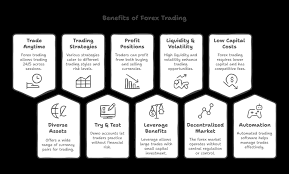
Global Economic Exposure
Trading the forex market provides insight into global economic conditions. Currency prices reflect interest rates, inflation, economic growth, and geopolitical developments.
By trading forex, individuals gain a deeper understanding of how global events influence financial markets. This broader perspective can improve overall financial awareness and decision-making.
Global exposure is a unique benefit that distinguishes forex trading from many local or single-market investments.
Development of Transferable Skills
Forex trading encourages the development of valuable skills such as analytical thinking, discipline, emotional control, and strategic planning.
Traders learn to manage risk, evaluate probabilities, and make decisions under pressure. These skills are applicable beyond trading, including in business and personal finance.
For many traders, the personal growth aspect is as valuable as potential financial returns.
Transparency and Market Efficiency
The forex market operates with a high level of transparency driven by global participation and real-time pricing. Economic news, data releases, and central bank announcements are widely available.
This transparency helps traders make informed decisions and reduces information asymmetry. While no market is perfect, forex is considered relatively efficient compared to many alternatives.
Access to timely information is a significant benefit for traders who value data-driven decision-making.
Realistic Expectations and Responsible Trading
Despite its many advantages, trading the forex market is not without risk. Success requires education, discipline, and realistic expectations.
The benefits of forex trading are best realized by those who view it as a long-term skill rather than a quick source of income. Losses are part of the learning process, and responsible risk management is essential.
Understanding both the opportunities and challenges allows traders to approach the market with confidence and balance.
Who Can Benefit Most from Forex Trading?
Forex trading is suitable for individuals who enjoy learning, analysis, and self-improvement. It appeals to those who value flexibility and global market exposure.
However, it may not be ideal for individuals seeking guaranteed returns or minimal involvement. Like any financial activity, success depends on commitment and preparation.
Knowing your goals and risk tolerance is essential before entering the forex market.
Final Thoughts on the Benefits of Trading the Forex Market
The forex market offers a unique combination of liquidity, accessibility, flexibility, and opportunity. From 24-hour trading and low entry barriers to advanced tools and global exposure, the benefits of forex trading are substantial.
When approached responsibly, trading the forex market can be both educational and rewarding. The true value lies not only in potential profits but also in the skills and insights gained along the way.
By focusing on learning, discipline, and risk management, traders can take full advantage of what the forex market has to offer while building a sustainable trading journey.
Summary:
Marquez, author of The Part-Time Currency Trader, outlines the benefits of trading the forex market.
Keywords:
forex, currency, currencies, trading, invest, wealth
Article Body:
Historically, the FX market was available most to major banks, multinational corporations and other participants who traded in large transaction sizes and volumes. Small-scale traders including individuals like you and I, had little access to this market for such a long time. Now with the advent of the Internet and technology, FX trading is becoming an increasingly popular investment alternative for the general public.
The benefits of trading the currency market:
It is open 24-hours and it closes only on the weekends;
It is very liquid and efficient;
It is very volatile;
It has very low transaction costs;
You can use a high level of leverage (borrowed money) with ease; and
You can profit from a bull or a bear market.
Continuous, 24-Hour Trading
The currency exchange is a 24-hour market. You may decide to trade after you come home from work. Regardless of what time-frame you want to trade at whatever time of the day, there would be enough buyers and sellers to take the other side of your trade. This feature of the market gives you enough flexibility to manage your trading around your daily routine.
Liquidity And Efficiency
When there are a lot of buyers and a lot of sellers, you can expect to buy or sell at a price that is very close to the last market price. The currency market is the most liquid market in the world. Trading volume in the currency markets can be between 50 and 100 times larger than the New York Stock Exchange (Source: Oanda.)
When you are trading stocks, you may have experienced events where one piece of news accelerates or decelerates the price of the underlying stock you may have bought into. Perhaps a director has been kicked out by the shareholders of a company or the company has just released a new product and big investors are buying the shares of a particular company. Share prices can be drastically affected by the actions or inactions of one or a few individuals. So if you are relying on television reports and newspapers to get your news, most of the opportunities or warnings will have come too late for you to take advantage by the time you get them.
The value of currencies on the other hand is affected by so many factors and so many participants that the likelihood of any one individual or group of individuals drastically affecting the value of a currency is minute. Because of its sheer size, the currency market is hard to manipulate. The ability for people to engage in �insider trading’ is virtually eliminated. As an average trader, you are less disadvantaged. You are likely to be playing on relatively equal ground along with all the other traders and investors whom you are competing against.
Note about price gaps:
For those people who have already traded other markets, you probably know about price �gaps’. �Gaps’ occur when prices �jump’ from one price level to another without having taken any incremental steps to get there. For example, you may be trading a share that closes at $10 at the end of today but due to some event that happens overnight; it opens tomorrow at $5 and continues to go downwards for the rest of the day.
Gaps bring about another degree of uncertainty that may meddle with a trader’s strategy. Probably one of the most worrying aspects of this is when a trader uses stop-losses. In this case, if a trader puts a stop-loss at $7 because he no longer wants to be in a trade if the share price hits $7, his trade will remain open overnight and the trader wakes up tomorrow with a loss bigger than he may have been prepared for.
After looking at a couple of forex charts, you will realize that there are little price �gaps’ or none at all, especially on the longer-term charts like the 3-hour, 4-hour or the daily charts.
Volatility
Trading opportunities exist when prices fluctuate. If you buy a share for $2 and it stays there, there is no opportunity to make a profit. The magnitude of level of this fluctuation and its frequency is referred to as volatility. As a trader, it is volatility that you profit from. Large volume transactions and high liquidity combined with fewer trading instruments generate greater intra-day volatility in the currency market that can be exploited by day-traders. The high volatility of the currency market indicates that a trader can potentially earn 5 times more money from currency trading than trading the most liquid shares.
Volatility is a measure of maximum return that a trader can generate with perfect foresight. Volatility for the most liquid stocks are between 60 to 100. Volatility for currency trading is 500. (Source: Oanda.)
In this respect, currencies make a better trading vehicle for day-traders than the equity markets.
Low Transaction Costs
A currency transaction typically incurs no commission or transaction fees. For a forex trader, the spread is the only cost he or she needs to cover in taking on a position. In addition, because of the currency market’s efficiency, there is little or no �slippage’ costs.
�Slippage’ is the cost involved when traders enter the market at a price worse than the level they wanted to get into. For example, a trader wants to buy a share at $2.00 but by the time, the order gets executed, his gets to buy the shares at $2.50. That fifty cents difference is his slippage cost. Slippage cost affects large-volume traders a lot. When they buy large quantities of a commodity, it oversupplies the market with buy orders. This applies a pressure for the price to go up. By the time they get to buy all the quantities they wanted, the average price they got their commodities would be higher than the price they intended to get them for. Conversely, when they sell large quantities of a commodity, they oversupply the market with sell orders. This applies a pressure for the price to go down. By the time they finish selling all their commodities, their average selling price is less than what they initially intended to sell them for.
Due to lower transaction costs, minimum slippage and strong intra-day volatility, individuals can trade frequently at small costs. As an approximate, you may only expect to have a spread of 0.03% of your position size. To give you an example, you can buy and sell 10,000 US Dollars and this will only incur a 3-point spread, equivalent to $3.
Leverage
There are not a lot of banks or people who would lend you money so that you can use it to trade shares. And if there are, it would be very hard for you to convince them to invest in you and in your idea that a certain share is going to go up or down. Therefore, most of the time, if you have a $10,000 account, you can only really afford to buy $10,000 worth of stocks.
In currency trading however, because you use �borrowed money’, you can trade $10,000 of a currency and you only need anywhere between fifty (For a margin lending ratio of 200:1) to two hundred dollars ( For a margin lending ratio of 50:1) in your trading account. This makes it possible for an average trader with a small trading account, under $10,000 to be able to profit sufficiently from the movements of the currency exchange rates. This concept is explained further in The Part-Time Currency Trader.
Profit From A Bull And Bear Market
When you are trading shares, you can only profit when the price of a stock goes up. When you suspect that it is about to go down or that it is just going to be moving sideways, then the only thing you can do is sell your shares and stand aside. One of the frustrations of trading shares is that an individual cannot profit when prices are going down. In the currency market, it is easy for you to trade a currency downward so that you can profit when you think it is going to lose value. This is easy to do because currency trading simply involves buying one currency and selling another, there is no structural bias that makes it difficult to trade �downwards’. This is why the currency market has been occasionally referred to as the eternal bull market.
This is an excerpt, modified from the book: The Part-Time Currency Trader .
Tinggalkan Balasan